

- Mettre en route la vidéo
- Cliquer sur l’icône « CC » (Sous-titre) en bas à droite
- Cliquer sur l’icône « Settings » (Paramètre) en bas à droite
- Cliquer sur «Subtitles » (Sous-titres)
- Cliquer sur « Auto-translate » (Traduire automatiquement)
- Sélectionner la langue de votre choix
Investigative Reporter Bruce Livesey on the Irving legacy
Following the deaths of J.K. and Arthur Irving, a number of obituaries and news stories in the mainstream media have omitted or downplayed longstanding critiques of their vast industrial holdings and controversial business practices.
Investigative reporter Bruce Livesey provided a different take in his 2017 series of articles titled the House of Irving, published by Canada’s National Observer. In an interview, he argued that the Irving businesses have worsened poverty and other social ills in New Brunswick, in part by using their monopoly or oligopoly position to drive down wages.
“When you don’t have competition, you can really dictate wages without much concern,” Livesey told the NB Media Co-op.
He pointed to massive government subsidies for the Irving companies and their practice of using offshore tax shelters, saying those factors have contributed to conditions of austerity in New Brunswick.
“Both the municipal and provincial government in New Brunswick didn’t have a lot of money to help the poor, to have reasonable rates of, say, welfare payments,” he said.
As for their newspapers, he noted that as a young reporter in the 1980s, he spent two summers working for the Daily Gleaner, where he saw firsthand how their editorial processes functioned.
“I was doing a story about the regulation of pesticides in New Brunswick,” including Agent Orange, which hadn’t yet been banned by the feds, he recalled.
“When [the editors] realized what I was up to, they killed that story.”
And while the Telegraph-Journal described Arthur Irving as “an energetic man who shook hands with everyone he met,” Livesey said the oil entrepreneur was “known as a bully, and thin-skinned and vindictive.”
For example, following Arthur Irving’s 1980 divorce, “he ordered his children not to have anything to do with their mother,” Livesey said.
In official communications, the Irving companies typically emphasize their charitable donations, multimillion-dollar investments, and other good news stories. Sometimes they go on the offensive against critical reports.
In one case, JDI’s vice-president of communications, Mary Keith, demanded that the CBC retract a story by Poitras about the 2015 firing of New Brunswick’s then-chief medical officer of health, Dr. Eilish Cleary.
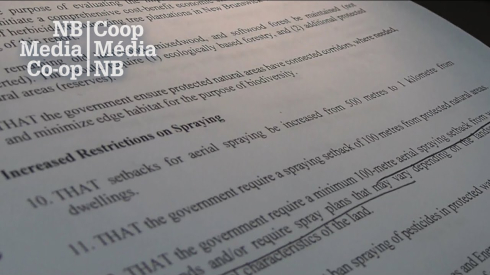
When Cleary was placed on leave prior to her firing, she was studying the health effects of the herbicide glyphosate, deemed a probable carcinogen by the World Health Organization earlier that year.
At the time, Poitras noted in his article that glyphosate is used by JDI in its forestry operations, and by NB Power. This brief mention was met with a severe backlash from JDI.
The company said the CBC had “presented an unsubstantiated conspiracy theory as fact,” by insinuating a connection between Cleary’s leave of absence, her study of glyphosate, and the two companies mentioned in the report.
JDI demanded that the CBC not only remove the story, but also “publish a full retraction, and apologize for their appalling behaviour.” CBC refused, and the story remains online today.
The company went on to lodge two consecutive complaints with the CBC demanding that it ban Poitras from covering the family and their businesses. But the broadcaster rejected those complaints, with the ombudsman saying it would “amount to a form of censorship.”
JDI ultimately failed in its bid to muzzle a prominent CBC journalist. But if coverage in recent months is any indication, very few reporters or media outlets want to rock the boat when it comes to the Irving family, suggesting a pervasive chill in the media industry that has outlived J.K. and Arthur Irving.
Read the full story on our website, nbmediacoop.org.
David Gordon Koch is a journalist with the NB Media Co-op who formerly worked as a reporter for the Moncton Times & Transcript when it was owned by J.D. Irving Inc. This reporting has been made possible in part by the Government of Canada, administered by the Canadian Association of Community Television Stations and Users (CACTUS).
Ajouter un commentaire

Médias récents

Connecting Gaza: New Brunswickers are Among a Network Supporting Families Amid Genocide

Canadian News Media Complicit In Israeli Genocide cover-up, Says Veteran Journalist

Delays on Herbicide Restrictions Show Province Aims to Protect Industry, says Green MLA
Commentaires
Nous encourageons les commentaires qui favorisent le dialogue sur les histoires que nous publions. Les commentaires seront modérés et publiés s'ils respectent ces lignes directrices:
Le portail des médias communautaires se réserve le droit de rejeter tout commentaire ne respectant pas ces normes minimales.